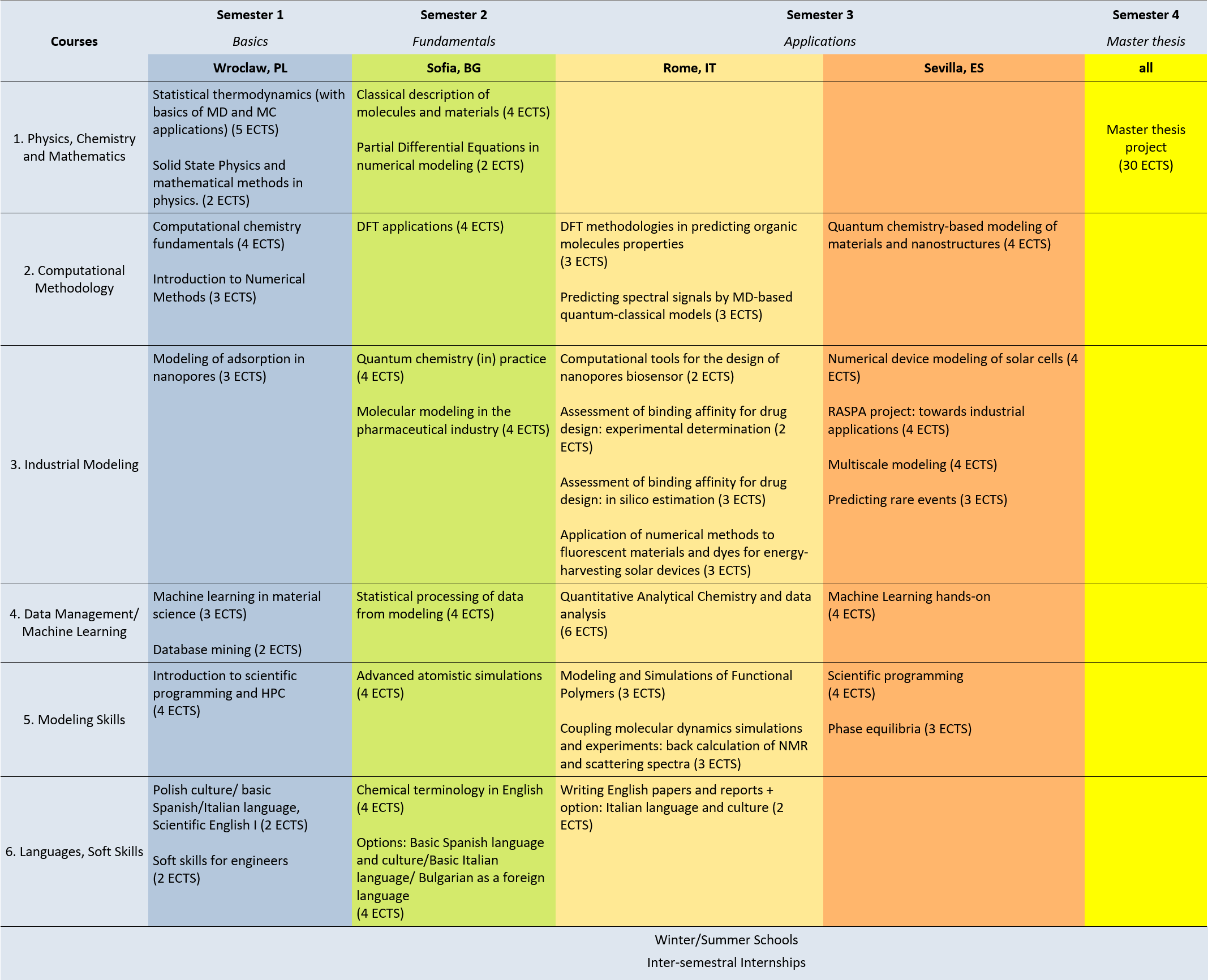
Study program
The EMJM-INANUM study program comprises seven modules outlined below (all taught in English) that ensure a progressive learning experience in fundamentals and methodologies, complemented by engineering projects geared toward developing essential design skills. Over the course of two years (four semesters – S1 to S4), students will acquire the full range of methods and methodologies required to proficiently employ numerical modeling as a supporting tool in industrial applications, with a particular focus on the nano-engineering domain. The first year of studies is common for all the students and features courses delivered in Wroclaw, PL (S1) and Sofia, BG (S2). The third semester (S3) will allow the students to choose between two modeling options: one oriented more towards a support of industrial laboratories (Rome, IT) and one towards a support of industrial applications (Sevilla, ES). For the Master thesis research project (S4 semester: Wroclaw, Sofia, Rome,Seville or one of other Partner Institution) the student can choose the project from the list of the relevant research project. The Master thesis project is concluded with a public presentation of a Master’s Thesis in Wroclaw, PL.
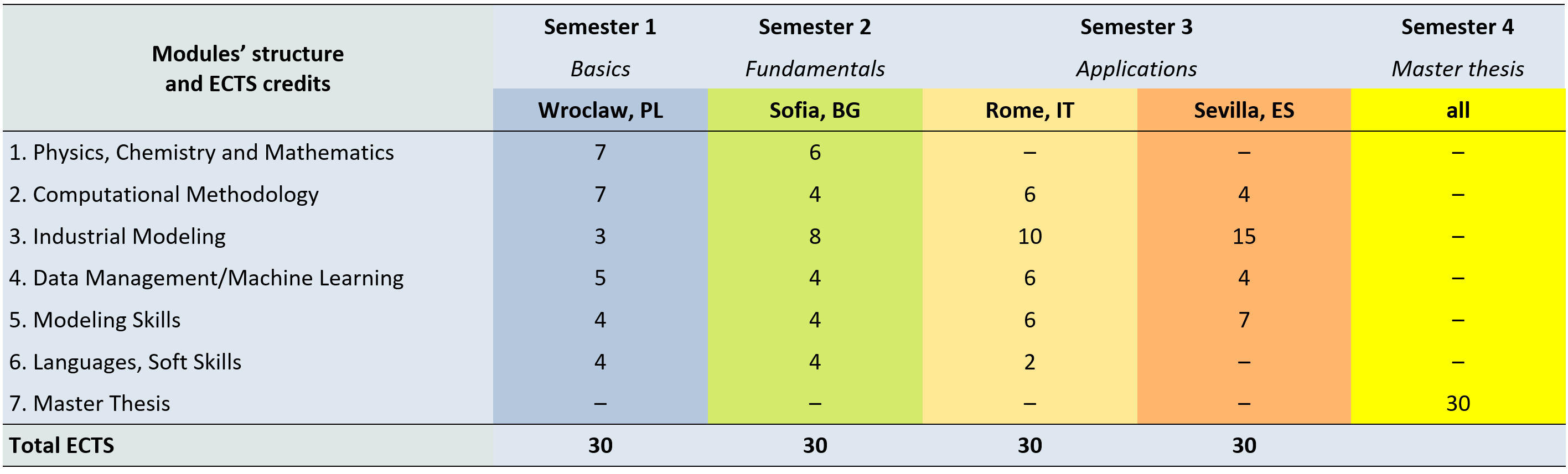
Each module encompasses a set of courses listed below that target specific skills and expertise to ensure that students receive a comprehensive and cohesive education, covering fundamental knowledge, specialized methodologies, practical skills, and opportunities for hands-on experience in the field:
- Physics, Chemistry and Mathematics module
provides a common foundation and ensures that all students start on the same level when embarking on the core courses of the Master’s program. - Computational Methodology module
imparts the methodology required for atomistic simulations and quantum calculations based on Density Functional Theory. - Industrial Modeling Methodology module
is instrumental in preparing students for the practical aspects of modeling in an industrial context. - Data Management/Machine Learning module
equips students with the skills needed to effectively handle and manipulate large datasets, as well as introduce them to machine learning techniques. - Modeling Skills module
covers the necessary skills for efficiently working with modeling software, including modifying open-access tools and effectively managing modeling inputs and results. - Languages, Soft Skills module
focuses on three crucial aspects: language proficiency (especially in English), cultural aspects of European heritage, and the development of transversal soft skills necessary for future graduates. - Master Thesis module
is exclusively dedicated to the final (fourth) semester, where students undertake their Master’s thesis project or internship in one of our partner institutions, including those in the industrial sector.